
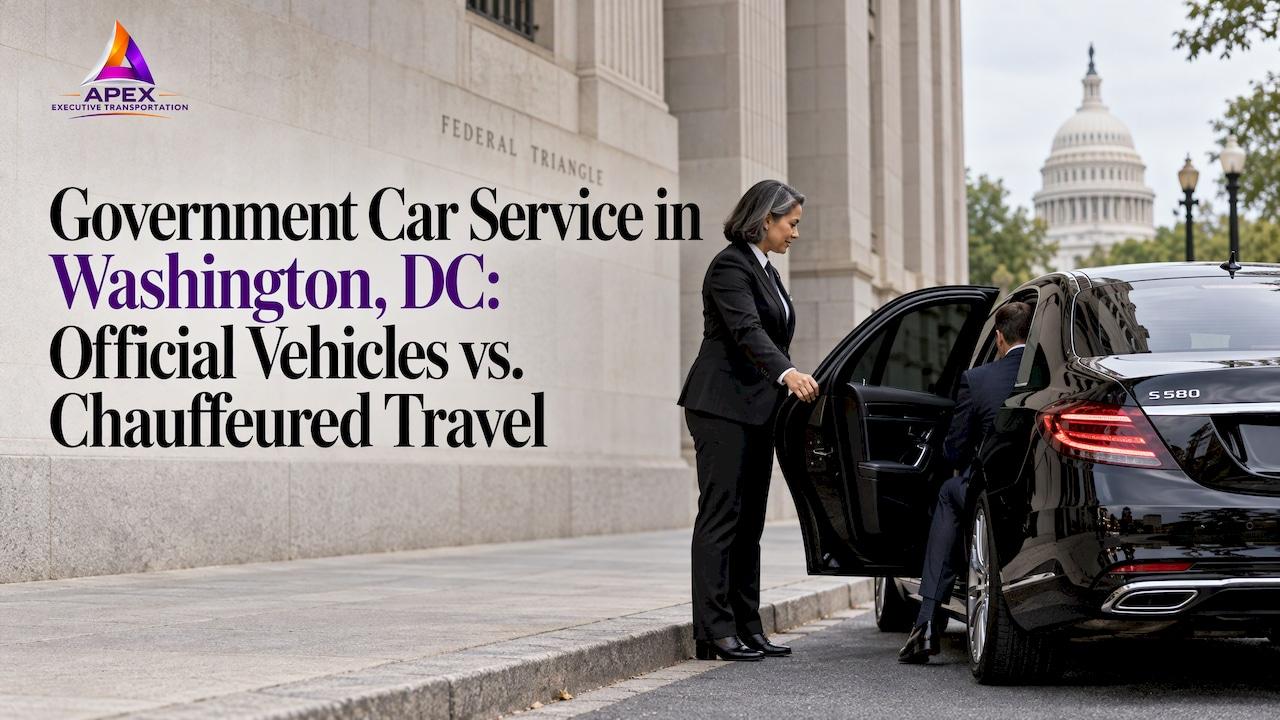
"Government car service" means two different things. One is an official vehicle the government owns or leases and assigns to employees for agency business. The other is a private chauffeured car service that moves government officials, contractors and business travelers around Washington, DC, Northern Virginia and Maryland. This guide explains the difference, what the federal rules say about official vehicles, and how to arrange chauffeured transportation when an official vehicle is not the right tool.
TL;DR
- An official government vehicle is owned or leased by the government and may be used only for official purposes. A chauffeured car service is a separate, commercially arranged ride.
- Federal travel rules allow agencies to authorize taxis, rental cars and other special conveyances for official travel, and some agencies allow private driver services with advance notice and a receipt.
- Home-to-work use of an official vehicle is tightly restricted. Comfort or convenience is not enough to justify it.
- For airport transfers to DCA, IAD and BWI, hourly service and discreet point-to-point travel, we provide professional chauffeurs and premium vehicles across the region.
- Confirm your agency's rules first, then request a quote with your flight, pickup and timing details.
Table of Contents
- What "government car service" actually means
- When federal employees may use an official vehicle
- When a chauffeured service fits official and executive travel
- What a chauffeured service can arrange for officials and business travelers
- How airport pickups, delays and waiting time are handled
- Checklist before you book: what a travel coordinator should confirm
- Serving the whole DC region
- Our perspective on executive ground transportation
- Plan your next trip with Apex
- FAQ
- Sources
What "government car service" actually means
The phrase covers two separate categories, and mixing them up causes real problems for travel coordinators.
Official government vehicles. Under federal fleet regulations, a Government motor vehicle is one the Government owns or leases, including vehicles obtained through purchase, excess, forfeiture, commercial lease or a GSA Fleet lease. These are the sedans, SUVs and vans assigned to an agency for its mission. They are driven by agency employees, and their use is governed by regulation.
Chauffeured car services. A chauffeured service is a private company that provides a professional driver and a vehicle for a trip or a block of hours. The traveler or the organization books it, and it is not an agency asset. For official travel, federal rules recognize that agencies may authorize common carriers, Government vehicles, privately owned vehicles, and special conveyances such as taxis, rental cars and transportation network companies.

So when someone in Washington searches for a government car service, they may want to understand what an official vehicle can be used for, or they may need a dependable ride for an official, a delegation or an executive. Both questions deserve a straight answer.
When federal employees may use an official vehicle
The rules are strict, and they are worth knowing before anyone plans a trip around an assumption.
Official purposes only
Under 41 CFR § 102-34.200, official use means using the vehicle to perform the agency's mission, as authorized by the agency. On temporary duty (TDY), a Government vehicle may be used only for official purposes. That includes travel between places of official business, between those places and temporary lodging when public transportation is unavailable or impractical, and to places necessary for sustenance, comfort or health, such as restaurants and drug stores.
Commuting is not automatic
A regular commute is not official use. Home-to-work transportation is allowed only in narrow cases: field work, a clear and present danger, an emergency, or a compelling operational consideration. It requires authorization from the agency head after the determination required by 31 U.S.C. 1344. According to 41 CFR § 102-34.205, that authority cannot be delegated, and comfort or convenience is not sufficient justification.
Individual agencies add their own conditions. The State Department's Foreign Affairs Manual says official vehicles are authorized only for authorized individuals performing Department business, and that operators must follow local, county and state laws as well as Department rules.
Misuse has consequences
An employee is responsible for any additional cost resulting from unauthorized use and may face administrative or criminal liability for misuse of Government property. The practical lesson for a travel coordinator: do not stretch an official vehicle to cover trips it was not authorized for. Plan a compliant alternative instead.
When a chauffeured service fits official and executive travel
Official vehicles are built around agency missions. Plenty of trips in the capital region fall outside that: an arrival at Dulles for a visiting delegation, a contractor's executive team attending meetings in Tysons Corner, a senior official's early departure from Arlington, a diplomatic guest who needs discretion and a punctual driver.
Federal travel regulations make room for commercial ground transportation. For TDY, 41 CFR § 301-10.420 allows reimbursement of the usual fare plus a reasonable tip for a taxi, TNC, shuttle service or other courtesy transportation when the agency authorizes and approves it. It also directs that when choosing a TNC, first consideration goes to the GSA ridehail program.
The same regulation spells out the covered trips. At the official station, taxi or TNC use is reimbursable from residence to airport, airport to residence, and between residence and office on the day of departure or return for TDY requiring at least one night's lodging. At the TDY location it covers movement between transit stations, lodging and places of official business.
Private driver services in agency policy
Some agencies address private drivers directly. The Nuclear Regulatory Commission's Management Directive 13.4 says that when an executive determines that a personal vehicle, public transportation, taxi or ridesharing does not meet their transportation requirements, the executive may arrange for a private driver service with 24 to 48 hours' advance notice. The executive pays directly on a personal credit card, and the cost is reimbursed as local travel. Any service over $75.00 needs a receipt attached to the reimbursement request.
That is one agency's policy, not a universal rule. It does show the pattern worth planning around: advance notice, a clear receipt, and a documented reason. Whatever your agency, check its own travel policy and your travel office before booking.
What a chauffeured service can arrange for officials and business travelers
A good executive car service covers more than a pickup. Here is what we provide across Washington, DC, Northern Virginia and Maryland.
- Airport transfers to DCA, IAD and BWI, with real-time flight tracking and complimentary wait times.
- Hourly chauffeur service for back-to-back meetings, Hill visits, site tours and days with a changing schedule.
- Corporate and government travel, including transfers between offices, hotels and agencies.
- Private aviation and FBO pickups for passengers arriving on private aircraft.
- Long-distance and out-of-state transfers from DCA and IAD to destinations beyond the metro area.
- Events, including weddings, celebrations and sporting events, with sedans, SUVs and vans.
Our full list of services shows how these fit together, and the fleet includes premium sedans, SUVs and vans so the vehicle can match the group size and the occasion. Service is available 24/7.
How airport pickups, delays and waiting time are handled
Airport travel is where a professional service earns its keep, because flights rarely arrive exactly on schedule.
Flight tracking. We monitor arrivals in real time, so the chauffeur's timing follows the actual landing, not the scheduled one. If a flight lands early or runs late, the pickup adjusts without a phone call from you.
Waiting time. Our service includes complimentary wait times, so a delayed deplaning or a slow customs line does not turn into a scramble. Share your flight number and terminal when you book, and the chauffeur plans around them.

Three airports, three habits. DCA sits minutes from downtown and Arlington, and many officials use it for short trips. Dulles is the main international gateway and serves Tysons Corner and McLean. BWI is the practical option for Bethesda-area and Maryland travelers heading to northbound flights. Our DCA and Dulles pages cover each airport in detail.
Private aviation. For FBO arrivals, the chauffeur meets the passenger at the facility, which keeps the handoff between aircraft and vehicle short and private.
Checklist before you book: what a travel coordinator should confirm
If you manage travel for an agency, a contractor or an executive team, settle these points before you book.
- Authorization. Confirm the trip is covered under your agency's travel policy and that the ground transportation is approved in advance where required.
- Lead time. Some policies ask for 24 to 48 hours' notice for a private driver. Book early, and expect to adjust if the schedule moves.
- Receipts. Ask for an itemized receipt for every ride. Reimbursement offices often need one, and the NRC directive above sets a $75.00 threshold.
- Flight details. Airline, flight number, terminal and passenger count let the chauffeur track and prepare.
- Pickup and drop-off points. Give exact addresses, building entrances and any security procedures.
- Confidentiality expectations. Tell the service whether the passenger prefers no conversation, no names on signage, or a specific meeting point.
- Vehicle size. Count luggage and briefcases as well as people, and choose a sedan, SUV or van accordingly.
- Contingency. Ask who the passenger calls if something changes, and confirm 24/7 availability for late arrivals and early departures.
A service built for executive travel will welcome these questions. Our chauffeurs are trained in executive protocol and confidentiality, and we ask for these details precisely because they make the ride smooth.
Serving the whole DC region
Government and corporate travel in the capital area crosses jurisdictions several times a day. We serve passengers from the District across the Potomac and into Maryland, with dedicated pages for the neighborhoods and business centers our clients use most:
- Washington, DC executive car service for downtown, Capitol Hill, embassies and hotels.
- Arlington, VA car service for Crystal City, Rosslyn and the Pentagon area.
- Alexandria, VA car service for Old Town and the surrounding offices.
- Tysons Corner car service for the region's corporate and contractor hub.
- McLean, VA car service for residential and corporate pickups.
- Bethesda, MD car service for the Maryland side of the metro area.
If you are planning a larger program, such as a multi-day visit with several vehicles, our corporate transportation planning guide walks through the logistics.
Our perspective on executive ground transportation
We work with people whose time and privacy matter: government professionals, executives, diplomats and private aviation passengers. What they ask of us is simple to say and demanding to deliver: arrive on time, be discreet, and make the ride effortless.
Official vehicles serve an agency's mission, and the rules around them are rightly strict. A chauffeured service fills a different need. It gives a traveler a prepared vehicle, a professional driver and a plan that adjusts when the flight does.
Our approach is designed around that. We track flights in real time, include complimentary wait times, and keep our chauffeurs trained in executive protocol and confidentiality. Our fleet of premium sedans, SUVs and vans is kept ready for the kind of day that starts at 5 a.m. at Dulles and ends after a late meeting in Bethesda.
When a trip is planned well, the passenger notices nothing except that everything went right. That is the standard we hold ourselves to.
APEX EXECUTIVE SERVICES
Plan your next trip with Apex
Whether you coordinate travel for a team or ride on your own schedule, we handle airport transfers to DCA, IAD and BWI, hourly chauffeur service, corporate and government travel, FBO pickups and long-distance transfers across the Washington region.

See our executive car services in DC or request a transportation quote with your pickup, destination, date and flight details. We will confirm the vehicle and arrangements with you.
FAQ
Is a chauffeured car service the same as an official government vehicle?
No. An official vehicle is one the government owns or leases and assigns for agency business. A chauffeured service is a private company that provides a driver and vehicle for a booked trip. Official travel rules let agencies authorize commercial options in certain situations, so check your agency's policy.
Can federal employees use an official vehicle to commute?
Generally no. Home-to-work use is limited to cases such as field work, emergencies, clear and present danger, or a compelling operational consideration, and the agency head must authorize it. Comfort or convenience does not qualify. Your agency's fleet or travel office can confirm what applies to you.
Can government travelers be reimbursed for a ride to the airport?
Often, when the trip is authorized. Federal travel regulations cover reimbursement for taxi and similar transportation between residence and airport on TDY days when the travel requires at least one night's lodging. Agencies set their own approval steps and receipt requirements, so confirm with your travel office before booking.
How far ahead should I book a car for an airport pickup?
As early as your plans allow. Some agency policies ask for 24 to 48 hours' notice for a private driver service. We operate 24/7 and track flights in real time, so share your flight number and terminal, and we will plan the pickup around the actual arrival.
What should I tell the car service about a sensitive trip?
Share the exact pickup point, passenger count, flight details and any preferences on signage, conversation or meeting location. Our chauffeurs are trained in executive protocol and confidentiality, and the more we know, the better we can prepare.
Sources
- eCFR: 41 CFR Part 102-34 Subpart A, General Provisions
- GSA: Federal Travel Regulation Overview (2023)
- eCFR: 41 CFR Part 102-34 Subpart D, Government Motor Vehicles
- GovInfo: 41 CFR § 301-10.201, Government Vehicle (2023)
- U.S. Department of State: 6 FAM 1940, Motor Vehicle Operators
- Cornell LII: 41 CFR § 301-10.420, Use of taxi, TNC and similar services
- GovInfo: Temporary Duty Travel Allowances, § 301-10.420 (2020)
- NRC: Management Directive 13.4, Transportation Management (2021)