
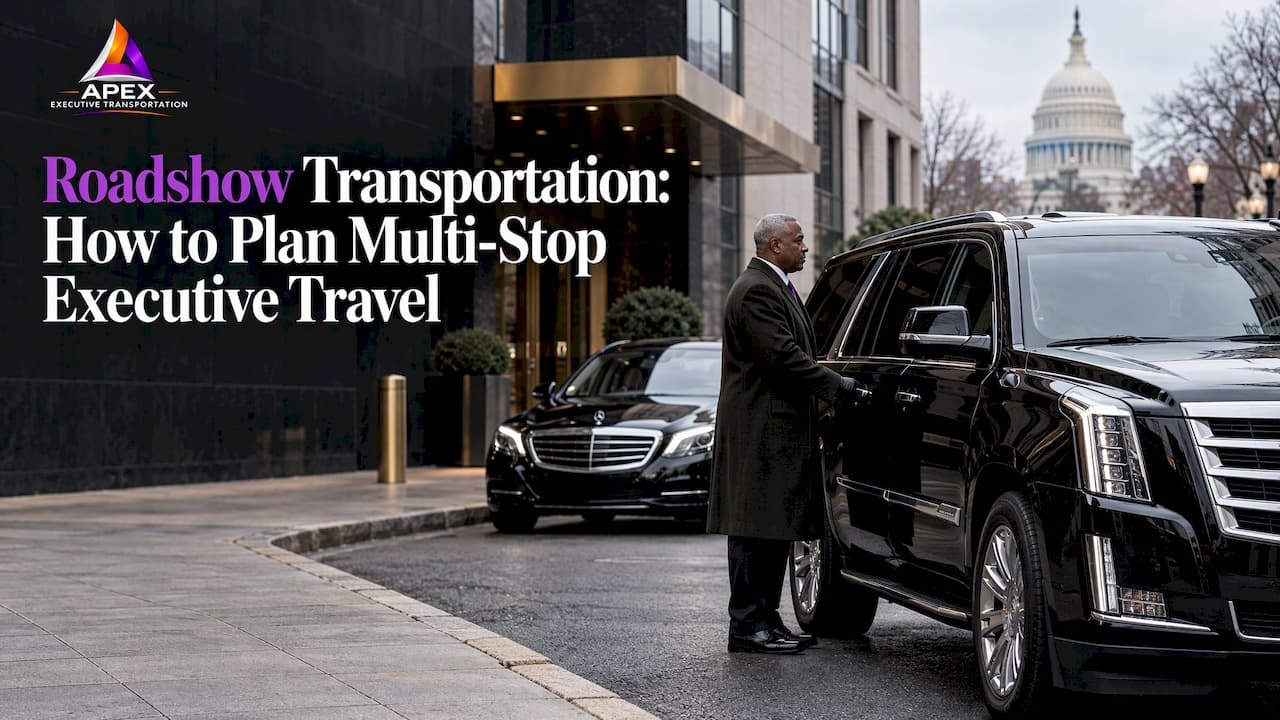
Roadshow transportation is the ground travel that moves a leadership team through a tight run of meetings, investor presentations or board sessions across several stops in a day or a week. The best way to run it is to put one dedicated chauffeur team on one master itinerary, build in buffers between stops, and tie every airport arrival to live flight data. This guide shows how to do that in Washington, DC, Northern Virginia and Maryland, where a single day can span Capitol Hill, Tysons Corner and Bethesda.
TL;DR
- A roadshow works when the whole itinerary is treated as one transportation plan, not a string of separate rides.
- Hourly, as-directed chauffeur service suits multi-stop days. Point-to-point transfers suit the arrival and departure legs.
- Link every airport pickup to flight tracking, and agree how long the chauffeur waits before the day begins.
- Confirm in writing the vehicles, the contact chain, the discretion expectations and the backup plan.
- Review each day against planned versus actual times so the next leg of the roadshow runs better.
Table of Contents
- What roadshow transportation actually covers
- Step 1: Build one master itinerary
- Step 2: Choose the right service type for each leg
- Step 3: Coordinate airport transfers with the itinerary
- Step 4: Board meeting transportation
- Step 5: Plan for discretion, security and punctuality
- Step 6: What to confirm with the chauffeur service
- Step 7: Manage the day and measure the result
- Our perspective on roadshow transportation
- Plan your roadshow with Apex
- FAQ
- Sources
What roadshow transportation actually covers
A corporate roadshow is a sequence of meetings in different places, usually with a fixed audience and a fixed clock. Companies use one to meet investors, brief clients, visit regional offices, present to agency leadership or gather directors for a board meeting that falls outside a normal office.
The transportation side is everything that carries people between those points: the airport pickup, the move from hotel to first meeting, the hops between stops, the working lunch, the return to the airport. The people in the car are often senior, the schedule is rarely forgiving, and the conversations in the vehicle can be confidential.
That is why a roadshow is not a taxi problem. It is a scheduling and trust problem, and the car is where both show up.
When companies choose a chauffeured roadshow
Teams usually move to chauffeured service when one or more of these is true:
- Three or more stops in a single day, with little slack between them.
- Executives who need to work, take calls or review materials between meetings.
- Guests, directors or officials who expect discretion.
- Arrivals at more than one airport, such as DCA, IAD and BWI, on the same trip.
- A schedule that moves, because a meeting runs long or a flight lands early.
In the Washington region, traffic patterns, secure buildings and three major airports add to the pressure. A driver who knows the area and stays with the group removes a whole layer of risk.
Step 1: Build one master itinerary
Start with a single document that every person involved can read. It should list, in order:
- Each traveler, with a primary contact for the group.
- Every stop, with the full address, building entrance and who meets the group there.
- The target arrival time and the hard start time for each meeting.
- Flight numbers, terminals and the scheduled arrival and departure for every airport leg.
- Meal stops and any private time the executives want between meetings.
Separate the arrival time from the start time. A car that arrives at 8:55 for a 9:00 meeting is already late, because the group still has to clear security and reach the room. Set the drop-off 15 to 20 minutes before the real start, and longer for buildings with screening.
Group the stops by geography
Where you have flexibility, order the meetings so the group moves in a logical arc. A morning in Arlington, a midday session at Tysons Corner and an evening in Bethesda is a very different day than bouncing between them. If the meeting times are fixed by the other party, plan the vehicle position around them and keep the chauffeur close to the next stop.
Our Tysons Corner car service and Arlington car service pages describe how we cover those business districts, which helps when a roadshow has stops in both.
Step 2: Choose the right service type for each leg
Most roadshows mix two kinds of service.
| Leg | Best fit | Why |
|---|---|---|
| Airport arrival or departure | Point-to-point transfer with flight tracking | The pickup follows the real landing time, not the scheduled one |
| Multi-stop meeting day | Hourly, as-directed chauffeur | One driver and one vehicle stay with the group through every change |
| Long hop to another city or state | Long-distance chauffeur transfer | Work time in the car, no handoffs |
| Large delegation | Mix of SUVs and vans | Keeps the group together or splits it by role |
| Private aviation arrival | FBO pickup | The car meets the group at the aircraft side of the trip |
Hourly service is the backbone of a roadshow day. The chauffeur is yours for the block of time, so a meeting that runs 25 minutes over changes nothing about the transportation. You do not rebook, re-explain or wait for a new car.
We provide hourly chauffeur service and corporate transportation across Washington, Northern Virginia and Maryland, with sedans, SUVs and vans, so the vehicle can match the group.
Matching vehicles to travelers
Think about who rides together. A principal and one aide fit a sedan. A team of four with laptops and materials usually needs an SUV. A delegation of eight or more, or a group that wants to travel as one, calls for a van. If directors arrive separately, plan separate vehicles for the airport legs and consolidate for the meeting day.

Tell the transportation provider about luggage, presentation equipment and any accessibility needs at the start. Those details decide vehicle choice more than headcount does.
Step 3: Coordinate airport transfers with the itinerary
Airports are where roadshow plans most often slip, because the arrival is the one time you do not control.
Three practices keep the first leg clean:
- Use flight tracking. The chauffeur should follow the flight, so an early landing or a delay is already known before anyone asks. We use real-time flight tracking on airport transfers.
- Agree the wait time up front. Know how long the chauffeur will wait after landing and how that is handled. Our airport service includes complimentary wait times, which takes the pressure off a group collecting bags.
- Pick the right airport for each traveler. Reagan National (DCA) is closest to downtown DC and Arlington. Dulles (IAD) is closer to Tysons Corner and McLean and the western suburbs. BWI is often convenient for Maryland meetings and for travelers coming up the Northeast corridor.
If different executives land at different airports, assign a chauffeur to each and give each a copy of the master itinerary with the shared meeting point. Details on each airport are on our DCA airport car service page and our IAD airport car service page.
Build in arrival buffers
Do not schedule a meeting within 90 minutes of a landing unless you have to. Bags, a restroom stop, a call with the office and the drive all take time. If the first meeting is critical, have the team arrive the night before.
Step 4: Board meeting transportation
A board meeting is a smaller version of a roadshow, with higher stakes on timing and privacy. The directors arrive from different places, must be in the room at the same moment, and often leave on tight flights.
What organizers should arrange:
- Staggered pickups that converge. Plan each director's pickup backward from the meeting start, with a shared drop-off point and entrance.
- A single point of contact. One person on the organizer side, one on the transportation side, reachable by phone the whole day.
- A return plan. Decide before the meeting whether cars wait, or come back at a set hour. A meeting that ends early or late should not strand a director.
- Private conversation in the car. Directors often discuss material matters on the way. Choose a provider whose chauffeurs are trained in confidentiality and executive protocol. Ours are.
- Accommodation for the chair or the guest of honor. Often a dedicated vehicle and driver for the most senior person simplifies everything else.
If the meeting is held at a hotel or office in DC, Bethesda or Tysons, have the chauffeur know the entrance, the drop-off rules and where to stage while the meeting runs.
Step 5: Plan for discretion, security and punctuality
These three get mentioned in every brief and handled in few.
Discretion
Decide what the chauffeur may know. Typically the driver needs the pickup, the destination and the timing, not the purpose of the meeting. Share names only to the degree needed to identify the passenger. Ask that the chauffeur not discuss the group, the schedule or the stops with anyone outside the booking. Government officials, diplomats and executives in sensitive deals often set these terms themselves, and a professional service expects it.
Security
Keep the itinerary on a need-to-know basis. Send the full plan to the transportation lead and the principals, and send each chauffeur only the legs they drive if the situation calls for it. Agree on a method for confirming identity at pickup, such as a name board or a pre-sent photo and vehicle description. If your own security team is involved, introduce them to the transportation contact before the trip.
Punctuality
Punctuality is a result of buffers, not of promises. Set the pickup earlier than the drive time requires. Stage the vehicle near the exit before a meeting ends. Account for the things you cannot control: weather, motorcades and road closures that are common in downtown DC. A chauffeur who works the area daily is likely to know the alternates before the group needs them.
Step 6: What to confirm with the chauffeur service
A roadshow is not the time to find out how the provider operates. Before the trip, get the following settled in writing:
- Vehicles and capacity for each leg, with a backup vehicle plan.
- Hours of coverage and availability. Our service is available 24/7, which matters for early flights and late dinners.
- Wait-time terms at airports and at meetings.
- How changes are handled on the day, and who to call.
- Cancellation and change terms for the booking.
- Operating authority and insurance when the trip crosses state lines.
That last point deserves attention, because many roadshows cross from DC into Virginia and Maryland. The FMCSA says that transporting passengers across a state line for any payment makes you a for-hire operation in interstate commerce, even if it happens only occasionally. The agency also says that for-hire passenger carriers in interstate commerce must carry minimum insurance: $1.5 million for vehicles designed for 15 or fewer passengers including the driver, and $5 million for vehicles designed for 16 or more. In general, the same page notes that such carriers need active interstate operating authority unless they operate within a commercial zone.
For an organizer, this means the vehicle size and the route both bear on what a provider must hold. Settle it as part of your normal vendor review, the same way you would any corporate supplier.
Step 7: Manage the day and measure the result
During the roadshow
- Hold a short briefing with the lead chauffeur before the first pickup.
- Keep one group message thread with the organizer, the transportation contact and the chauffeurs.
- Check in after every stop for the first day so small slips do not stack.
- Keep a printed copy of the itinerary in each vehicle.
When the schedule changes
Schedules change on nearly every roadshow. Decide ahead who may authorize changes, so a chauffeur is not waiting on a call that nobody is allowed to make. With hourly service, a change of order or a longer meeting is simply a change of direction, not a new booking. For a changed flight, the tracked arrival tells the chauffeur where to be.
Reviewing whether the plan worked
After each day, compare planned and actual times. A short review is enough:
| Measure | What to look at |
|---|---|
| Arrival margin | How early each group reached each meeting versus the target |
| Airport legs | Time from landing to the car moving |
| Changes | How many were made and how fast they were absorbed |
| Traveler feedback | Comfort, ability to work in the car, discretion |
| Gaps | Any stop where the plan was tight or the vehicle was wrong |
Carry the findings into the next leg of the roadshow, and into the next year's plan.
Our perspective on roadshow transportation
We see roadshows go wrong in the same few places: a pickup tied to a scheduled landing instead of the real one, a driver who is handed a new group at every stop, and a plan nobody can change without three phone calls.
Our answer is continuity. One chauffeur team, one itinerary and one contact for the whole trip. We track flights in real time, we include complimentary wait times, and we keep a luxury fleet of sedans, SUVs and vans so the vehicle fits the group and not the other way around.
Our chauffeurs are trained in executive protocol and confidentiality, because the car is often where the most candid conversation of the day happens. We are available around the clock, which matters when a roadshow starts before sunrise and ends after dinner.
We serve Washington, DC, Northern Virginia and Maryland, and the three airports that connect them. We treat a roadshow as one continuous experience, from the first pickup to the last drop-off.
APEX EXECUTIVE SERVICES
Plan your roadshow with Apex
We provide chauffeured transportation for corporate roadshows, board meetings and executive travel across the Washington metropolitan area: airport transfers at DCA, IAD and BWI, hourly chauffeur service for multi-stop days, long-distance transfers and private aviation FBO pickups. See our full list of services, or read our corporate transportation planning guide for Washington, DC for more on organizing a corporate program.

Tell us the stops, the dates and the group size, and we will build the transportation plan around them. Request a transportation quote.
FAQ
How far ahead should we book roadshow transportation?
Book as soon as the itinerary is reasonably firm, and before the dates fill with other events. Multi-day roadshows with several vehicles benefit most from early booking. You can still adjust details later, such as pickup times and flight numbers, as the plan settles.
Is hourly service better than booking each ride separately?
For a day with several stops, usually yes. A chauffeur who stays with the group absorbs delays and changes without a new booking at each stop. Separate point-to-point rides suit the airport arrival and departure legs, where a tracked flight sets the timing.
Can one chauffeur service cover DCA, IAD and BWI on the same roadshow?
Yes. We serve all three airports, so executives landing at different airports can each be met by a chauffeur and brought to the same meeting. Share the flight details for each traveler and the plan fits together.
What should we tell the chauffeur about confidential meetings?
Share the pickup, the destination and the timing, and keep the purpose of the meeting to yourselves. Ask for discretion in writing if the group needs it. Our chauffeurs are trained in executive protocol and confidentiality, and we expect the same standard on every trip.
What if a flight is delayed or a meeting runs long?
With real-time flight tracking, the chauffeur sees the delay and adjusts the pickup. With hourly service, a longer meeting simply extends the time the chauffeur is with you. Agree in advance who can approve changes so the day keeps moving.
Sources
- Multi-Modal Passenger Transportation, FMCSA
- Licensing and Insurance Requirements for For-Hire Motor Carriers of Passengers, FMCSA